
Why us
Why Tyne and Wear homeowners choose our barn conversions
Old buildings treated as old buildings
Lime mortars, breathable build-ups and repair before replacement. Modern materials on solid stone cause damage that shows up years later.
Structure assessed before you commit
We would rather find the problem in a trial hole than three months into the job.
Character kept, not recreated
Original openings, stone and roof structure retained wherever they can be. Once the character is knocked out it never really comes back.
What it is
Barn Conversions, built to last
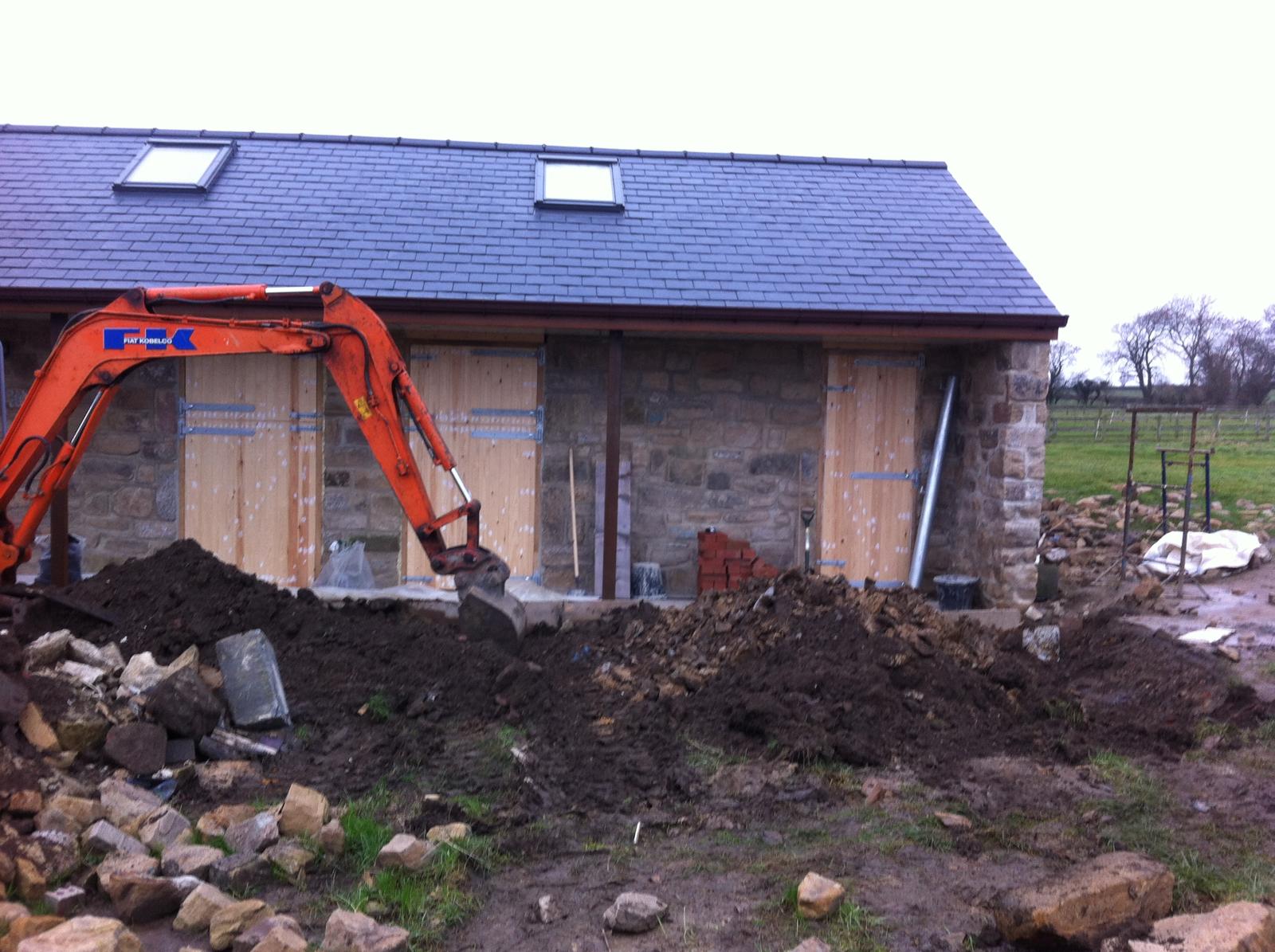
Barn and outbuilding conversions across Northumberland, the Tyne Valley and County Durham. These are not ordinary building jobs — the structure is old, rarely square, often stone, and usually has no foundations worth the name. The skill is in doing as little to it as possible while making it warm, dry and legal.
- Structural survey and underpinning where needed
- Stone repair, repointing and lime work
- New floors, insulation and damp proofing
- Roof structure repair and re-covering
- New openings formed sympathetically
- Full fit-out through to decoration
40 years in the trade. Domestic and commercial, across the North East.
Choices
The barn conversion options we offer
Full residential conversion
Agricultural building to house, under Class Q rights or full planning.
Annexe or holiday let
A smaller outbuilding brought into use — often the better return on a rural plot.
Garden and garage outbuildings
Stone outbuildings converted to workshop, office or store without full residential spec.
Ready for your free barn conversion quote?
A free site visit and a written quote, with no obligation and no chasing afterwards.
What is Class Q?
Class Q is a permitted development right that allows certain agricultural buildings to be converted to dwellings without full planning permission, subject to conditions on size, use history and structural condition.
It is not a shortcut. You still need prior approval, the building still has to be capable of conversion rather than rebuild, and building control applies as normal. We will tell you at the first visit which route your building is likely to fall down.
Where these buildings are
The Tyne Valley around Corbridge, Hexham, Stocksfield and Wylam, mid-Northumberland around Morpeth and Whalton, and rural County Durham are full of redundant stone agricultural buildings on good plots. Much of it is in conservation area or within an AONB, which changes what you can do to the outside — worth knowing before you fall in love with a set of drawings.
Looking after your barn conversion
Solid stone buildings want checking rather than treating. Look at the pointing, the rainwater goods and the ground levels against the wall once a year — most damp in a converted barn traces back to a blocked gutter or soil piled up against the base of the wall, not to the wall itself.
The GGH Build Standard
Our barn conversion process at a glance
How your barn conversion job actually runs, start to finish.
-
Free site visit
You show us round and tell us what you want. We measure up and talk through what it involves.
-
Written quote
An estimated cost with the scope in plain English. Groundwork the job needs is priced in here, not later.
-
The work
Structure stabilised and repaired first, then breathable insulation, new floors and a full internal fit-out.
-
Handover
We walk it with you and write the snagging list together. Not signed off until that list is empty.
In their own words
Trusted by homeowners across the North East
Real customers, real names, real jobs. Rated 5.0 from 4 reviews.
Barn Conversions
Common barn conversion questions
No. It needs to be structurally sound enough to convert without effectively rebuilding it, and it needs the right planning route — either Class Q permitted development rights or full permission. A barn that has already partly collapsed usually fails both tests, which is why we open up and look before pricing rather than after.
Lime, on any solid stone building. Cement pointing traps moisture in the stone, which then pushes out through the face and spalls it, and it is the single most common piece of damage we see on old buildings round here. It is more work and it is not negotiable.
Carefully, and usually with breathable materials. A solid stone wall is designed to take on water and release it. Wrap it in the wrong insulation and you stop it drying, and the moisture goes somewhere worse. We specify a breathable build-up on solid walls as standard.
Where we work
Areas we cover
Across Tyne and Wear, Northumberland and Teesside. Find your town below — no call-out charge anywhere we go.
Get a Free Quote
Free, no-obligation quote. No pressure, no chasing. We respond during working hours, Monday to Saturday.
40 years in the trade. Domestic and commercial, across the North East.